By Rachel Stilwell. Esq, -
What is "Fair Use?"An Analysis of Randi Zuckerberg’s Copyright Infringement of Dee Snider's Song "We're Not Gonna Take It" -
Cryptocurrency and NFT proponent Randi Zuckerberg (and sister of Meta/Facebook founder/CEO Mark Zuckerberg) recently posted to Twitter a music video in which she sings a so-called parody version of Twisted Sister’s classic rock anthem, “We’re Not Gonna Take It.” Zuckerberg changed the lyrics of Twisted Sister frontman Dee Snider’s musical composition to create a work called, “We’re All Gonna Make It.” According to Snider, Zuckerberg did not obtain permission from rightsholders to use the musical composition or change the lyrics. Zuckerberg’s widely panned music video features substituted lyrics promoting the purported benefits of cryptocurrency, NFT’s, and Web3 to those who partake in such trendy marketables.
Although we are acquainted with-- and fond of -- Dee Snider we don't represent him or any of the other parties involved in this case.
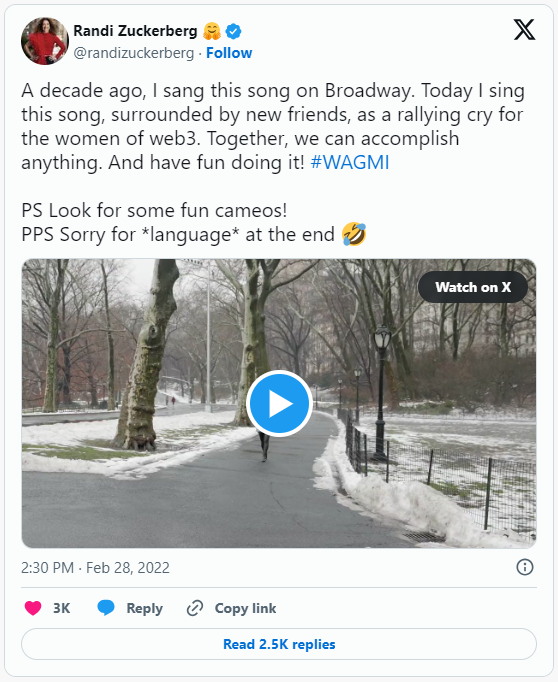
And here’s Twisted Sister’s original video:
Many commenters on Twitter asked whether Zuckerberg’s music video may have infringed Snider’s original hit musical composition. Other commenters surmised that Zuckerberg’s video must not be infringing because it looked (to them) like a “parody,” which they had heard was a category of works that are exempt from copyright law. It is true that creators of unlicensed parody works can, under certain circumstances, be deemed not liable for what would otherwise be considered copyright infringement. However, in this instance, it is not at all clear to us that Zuckerberg would be able to successfully make such a legal argument if faced with a claim by the rightsholders in the musical composition “We’re Not Gonna Take it.”
Having lifted the entire underlying melody from Snider’s musical composition, Zuckerberg likely infringed the copyright in the musical composition to promote her own commercial interests. Zuckerberg’s music video has received well over 3 million views on Twitter, much to the chagrin of Snider, who lamented Zuckerberg’s changing his lyrics and releasing the unauthorized video. See, Spencer Kaufman & Jon Hadusek, “Dee Snider Explores Legal Action Over Mark Zuckerberg Sister’s ‘Dog Shit’ Version of “We’re Not Gonna Take It,” Yahoo News, March 8, 2022, available at: https://www.yahoo.com/entertainment/dee-snider-explores-legal-action-192312972.html.
In light of the fact that Zuckerberg’s video features big hair and 1980’s-style graphics, many armchair legal commentators on Twitter immediately jumped to the conclusion that Zuckerberg’s video was a parody of Snider’s original composition, such that it qualified for the “fair use” defense. However, under U.S. copyright law, Zuckerberg’s unauthorized derivative work may not qualify as a fair use—and may not even qualify as a parody of the original work.
Under certain circumstances, parodies may be exempt from liability under the doctrine of fair use. However, such works must satisfy a statutory four-factor fair use test, as applied by the Supreme Court in its 1994 decision in Campbell v. Acuff-Rose Music, 510 U.S. 569 (1994). We believe that, in the event of an infringement claim against Zuckerberg for her creation of an unauthorized derivative work of Snider’s song, it is unlikely that a court applying those four factors would absolve Zuckerberg from liability on the basis of fair use. We apply that four-factor test, below.
Factor 1: Purpose and Character of Use: Is Zuckerberg’s New Work Transformative? Commercial?
The first of the four factors applied by SCOTUS in its Campbell decision addresses the “purpose and character” of the alleged infringer’s use of the underlying copyrighted work. This factor entails analysis of whether the nature of such use is “transformative” and/or, “commercial.”
According to the Court, a “transformative” use is one that “alter[s] the original [work] with new expression, meaning, or message.” In contrast, a new work that merely supersedes the purpose of the original work is unlikely to be considered transformative. Here, Zuckerberg’s song does little to musically transform Twisted Sister’s, “We’re Not Gonna Take It.” Unlike in Campbell, in which hip hop group 2 Live Crew borrowed only a short but well-known motif from Roy Orbison’s song, “Pretty Woman,” for incorporation into the group’s own song of the same name, Zuckerberg instead copied every note of the melody of Snider’s classic anthem. Zuckerberg did this, apparently, without permission or license. Thus this is a classic example of copyright infringement. Nevertheless, Zuckerberg could potentially avoid liability for such infringement if she were to successfully assert a “fair use” as an affirmative defense in court.
Zuckerberg did substantially change Snider’s lyrics (to fit her “dog shit” video, per a quote from Snider). Zuckerberg’s legal team would undoubtedly argue that her lyrics constitute a transformative use of Snider’s song. However, Zuckerberg’s unauthorized lyrics simply appropriate the rebelliousness of “We’re Not Gonna Take It.” Zuckerberg appropriates the purpose of Dee Snider’s copyrighted work to imply that it would be “rock and roll” for her audience to “buy ‘em up and hold on tight,” when in fact, as we head into Spring 2022, hyping crypto and NFTs are about the most “bandwagon” thing happening right now.
Moreover, we believe that under SCOTUS’ analysis in Campbell v. Acuff-Rose, Zuckerberg’s lyrics (and sound recording of her performance) cannot be said to be a parody. The Court in Campbell defined parody as a “literary or artistic work that imitates the characteristic style of an author or a work for comic effect or ridicule.” (emphasis added). Importantly, the Court advised that:
“the heart of any parodist's claim to quote from existing material is the use of some elements of a prior author's composition to create a new one that, at least in part, comments on that author's works. . . . If, on the contrary, the commentary has no critical bearing on the substance or style of the original composition, which the alleged infringer merely uses to get attention or to avoid the drudgery in working up something fresh, the claim to fairness in borrowing from another's work diminishes accordingly (if it does not vanish), and other factors, like the extent of its commerciality, loom larger.” Campbell v. Acuff-Rose, 510 U.S. at 580 (emphasis added).
In Campbell, 2 Live Crew copied the first line of Roy Orbison’s lyrics, but then departed markedly. 2 Live Crew’s lyrics “quickly degenerated into a play on words . . . derisively demonstrat[ing] how bland and banal the Orbison song seem[ed] to them.” (emphasis added) The Court emphasized this “joinder of reference and ridicule that marks off the author's choice of parody from the other types of comment and criticism that traditionally have had a claim to fair use protection as transformative works.”
Considering the above language from Campbell v. Acuff-Rose, and Zuckerberg’s clear lack of reference or ridicule aimed at Snider’s song, Zuckerberg’s use cannot clearly be said to be a parody. Although the music video includes footage appearing to incorporate 1980’s graphics and big hair, those elements that could be said to comment on the silliness of 80s music are strictly visual. Crucially, the music video is a different copyrightable work than Zuckerberg’s underlying sound in which she sings her new lyrics to Snider’s musical composition. There is arguably nothing in either Zuckerberg’s sound recording or her version of the musical composition that has any “critical bearing on the substance or style of the original composition” by Dee Snider.
Since Zuckerberg’s unauthorized work does not criticize or poke fun at the substance of Snider’s song, as any parody must, she lazily does what SCOTUS and the Ninth Circuit Court of Appeals have excluded from the category of parody. Zuckerberg rips off Snider’s entire melody, replacing Snider’s rebellious rock & roll lyrics with a promotional message about a category of products that Zuckerberg commercially endorses. As the Ninth Circuit stated in Dr. Seuss, “broadly mimic[king a] characteristic style” is not the same as holding such style up to ridicule, and without a critique of the substance of the copied work, all the infringer does is simply retell another tale, using the expressive elements of the infringed work "to get attention or maybe even to avoid the drudgery in working up something fresh." See Dr. Seuss Enters., L.P. v. ComicMix LLC at 452-453, citing Campbell at 1401.
It is tempting to analogize Zuckerberg’s video with others by “Weird Al” Yankovic, the king of musical parody. Lots of folks on Twitter suggested such comparison. However, there are clear differences between how Yankovic parodied countless pop songs and how Zuckerberg used Twisted Sister’s iconic rock anthem.
In addition to creating videos that spoof the style of parodied recording artists, Weird Al Yankovic consistently rewrites the lyrics of pop songs in a way that directly pokes fun at the substance of the underlying musical compositions from which he borrows. Accordingly, “Like a Virgin” was transformed into “Like a Surgeon,” while “Beat It” was transformed into “Eat It.” By comparison, Zuckerberg made only a minor tweak in the title of Snider’s iconic song, any attempted play on Snider’s words ended there. Thus, Zuckerberg’s unauthorized version of Snider’s composition is arguably not a transformative parody for purposes of fair use analysis. Moreover, notably, Yankovic has a policy of only doing do so with permission and license from each songs’ author, thus avoiding any possible controversy about copyright infringement.
Would a court find that Zuckerberg’s use of the composition was commercial in nature? The answer to that question would help us finalize analysis of the most interesting and complex factor to be applied under Campbell.
Zuckerberg appears to have confined the song’s presence to online viewing on ad-driven platforms rather than releasing her work for sale or on a subscription-only streaming basis. Still, Zuckerberg’s use of Snider’s song is nevertheless arguably commercial in nature. According to the Wall Street Journal, Ms. Zuckerberg has business relationships with several crypto and NTF companies, all of which she actively promotes on Twitter. She boasts of owning nearly 200 NFTs. Given her unauthorized work’s relentless stream of crypto jargon and calls to invest in coins and NFTs, those works could reasonably be seen as promoting Zuckerberg’s brand as an expert, or alternatively, those products she is shilling through her self-described business relationships.
Fair use analysis is a balancing test, in that it requires weighing all four factors before coming to a decision. While the first factor, “Purpose and Character of Use” (incorporating analysis of both “transformativeness” and “commerciality”) appears damning for Zuckerberg, no one factor can be dispositive. Thus, we dive into the remaining three factors, all of which are easier to analyze and therefore, discussion is relatively brief.
Factor 2: Nature of the Copyrighted Work
According to SCOTUS, the more creative an original work, the more protection it should be accorded from copying. Therefore, there may be greater license to use portions of fact-based, informational works like indexes or catalogs than more creative works. Since Snider’s original song was created for the express purpose of being performed by a quintessentially creative, theatrical 1980’s hair band, the original work cannot be said to be factually-based and must instead be deemed an inherently creative work quite worthy of protection.
Factor 3: The Amount and Substantiality of The Portion Used in Relation to The Copyrighted Work as a Whole
As discussed, Zuckerberg copies the entire melody from Snider’s original work. This amount of copying and use is far more substantial than the snippet of Orbison’s “Pretty Woman” used by 2 Live Crew. Clearly, this factor would weigh against a determination that Zuckerberg’s works qualified for a fair use defense.
Factor 4: Effect of Use Upon Potential Market of the Copyrighted Work
Zuckerberg’s video seems unlikely to permanently replace Twisted Sister’s iconic recorded performance. That is particularly true in light of the fact Twitter users have overwhelmingly panned Zuckerberg’s having co-opted the original anthem in her pathetic but successful attempt to obtain 15 minutes of unearned fame. See, David Caucci, “Mark Zuckerberg’s Sister Dropped a Crypto Anthem – and It’s Ruining Everyone’s Timeline: Could Crypto Be Any More Cringe?” Daily Dot, March 3, 2022, available at: https://www.dailydot.com/debug/randi-zuckerberg-crypto-anthem/. However, at over 3 million views, Zuckerberg’s video has reached a substantial audience, such that a court couldn’t rule out this factor leaning in favor of Snider.
Conclusion
Randi Zuckerberg torturing Dee Snider’s iconic song does not necessarily constitute a “fair use” just because many Twitter users describe her video as a parody. Zuckerberg’s lyrics are not about anything in Snider’s original musical composition and therefore, at least for purposes of analysis under Campbell, her work does not qualify as parody at all. Furthermore, Zuckerberg’s unauthorized work is arguably commercial in nature as a poorly veiled brand promotion that steals the entire melody of a highly creative work deserving of copyright protection. For those considering emulating Zuckerberg: the owners of the copyright you are about to infringe may wind up saying to their lawyers: “We’re Not Gonna Take It!”
1 A recent discussion of the fair use doctrine as an affirmative defense can be found in Dr. Seuss Enterprises, LP. v. ComicMix LLC, 983 F.3d 443 (9th Cir. 2020). In that case, the Ninth Circuit Court of Appeals found no fair use where a modern book titled, Oh, the Places You’ll Boldly Go!, copied Dr. Seuss’s, Oh, the Places You’ll Go!, but failed to comment or critique on the classic book. The Court held that the book could therefore not be said to be a parody, and further, was not transformative. According to the Court in Dr. Seuss, a successful fair use affirmative defense would not have resulted in a finding that no infringement had occurred. Rather, a successful assertion of the defense would have absolved the infringer of liability for damages, despite the fact that copyright infringement had occurred. See Seuss at 459.
2 See “Weird Al” Yankovic, “The Gaga Saga,” Al’s Blog, available at: https://alyankovic.wordpress.com/the-gaga-saga/.